
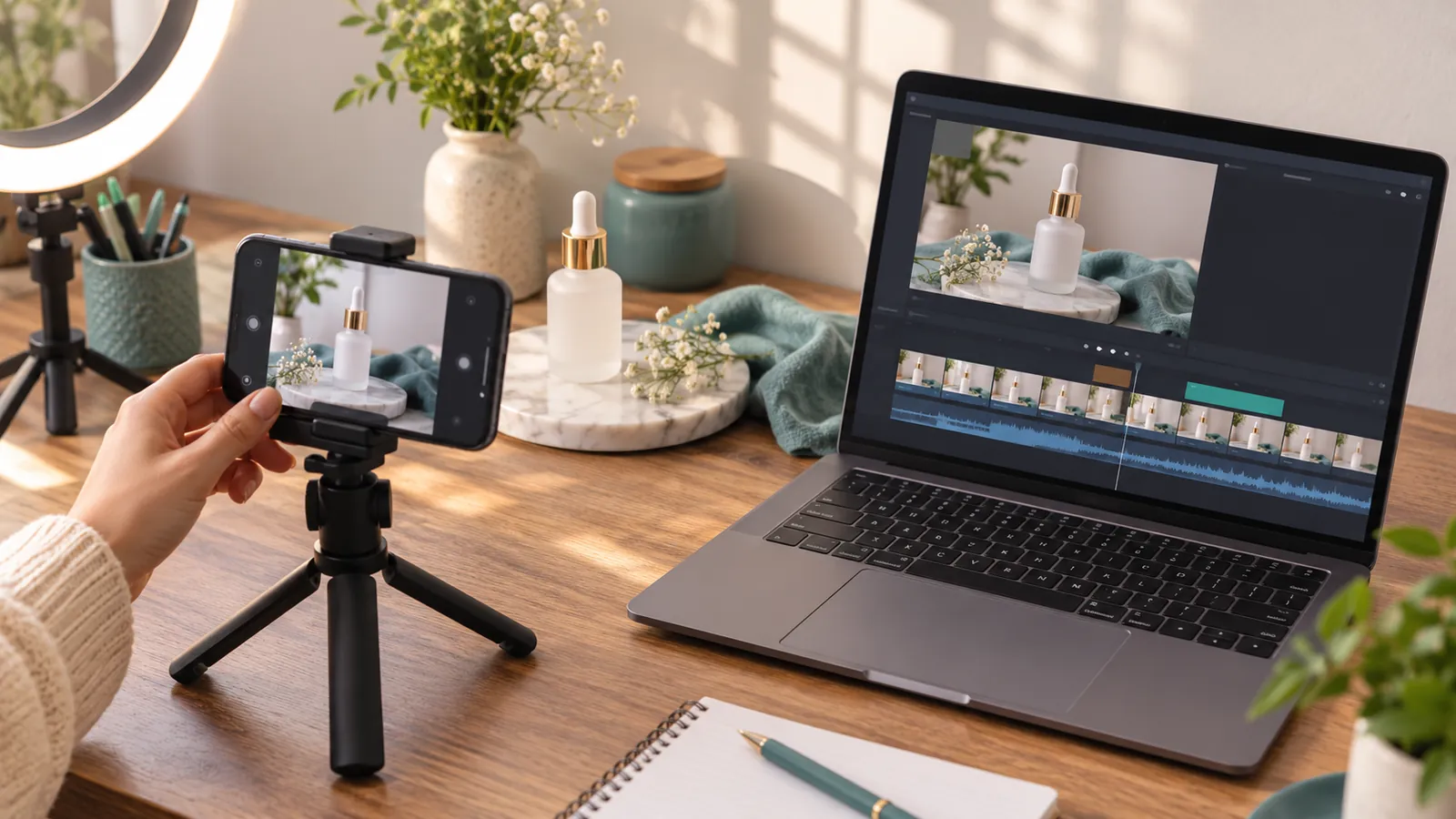
Quick answer: UGC ads are advertisements that use customer-created or creator-produced content to communicate a product or service in a relatable, experience-led way. Their effectiveness depends on more than looking like ordinary social media posts. A useful UGC ad addresses a real customer concern, demonstrates something relevant and gives viewers a believable reason to consider the product.
Introduction
A person talking about a product on camera, showing how it works or sharing an experience can communicate more naturally than a traditional advertisement. That is one reason user-generated content (UGC) has become an important part of social media advertising.
But there is a problem. As more brands adopt the format, many ads begin to look and sound alike: similar hooks, exaggerated reactions, scripted testimonials and repeated claims. The content starts to feel less like a genuine experience and more like another advertisement following a formula.
This does not mean UGC ads have stopped working. It means that copying the format is not the same as understanding why it can be effective.
In this guide, we’ll look at what UGC ads are, how to create more believable ones, how to brief creators without over-scripting them, and how to measure whether they are contributing to campaign results.
1. What Are UGC Ads?
UGC ads are paid advertisements that use content created in a user-generated-content style: product demonstrations, personal experiences, reviews, unboxing videos, tutorials or everyday situations. Unlike polished conventional ads, they usually have a conversational presentation.
For example, a skincare brand might show someone explaining how they added a product to their morning routine. A software company might use a screen recording to show how a feature solves a common problem.
The important distinction is that not every UGC-style ad is actually created by a customer.
Genuine customer UGC vs paid creator content vs AI-generated UGC
| Content type | Who creates it? | What makes it different? |
|---|---|---|
| Genuine customer UGC | An actual customer or user | Created from their own experience, independently or in response to a brand request |
| Paid creator content | A hired creator | Produced under a brand brief, usually with agreed deliverables and payment |
| AI-generated UGC-style ads | AI tools or production workflows | Uses synthetic or AI-assisted visuals, voices or characters to imitate the style of creator content |
A paid creator can produce authentic-feeling content. Payment alone does not make an ad dishonest. What matters is whether the message accurately represents the creator’s experience, whether the claims are truthful and whether the commercial relationship is disclosed.
Similarly, an AI-generated video may explain a product clearly, but an AI avatar should not be presented as a real customer sharing a personal experience that never happened.
2. Why Brands Use UGC Ads
People regularly encounter demonstrations, tutorials, recommendations and personal stories in their feeds, so ads in familiar formats fit more naturally into that experience. Brands use the approach for a few practical reasons:
- Demonstrations are easier to understand than claims. Showing how a task is completed in a software platform, or how a garment fits into different outfits, gives the viewer a clearer picture than a written promise.
- Experiences provide context. “This app saves time” is broad. A short video showing someone using the app to complete a specific task explains what the product does and why a feature might matter.
- The format allows different creative approaches. A customer explaining a problem, a creator demonstrating a feature, a tutorial, an unboxing or a comparison can all communicate the same benefit in different ways.
However, using a familiar format does not automatically make an ad persuasive. The content still needs to offer something relevant.
3. Why Authenticity Matters More Than Ever in 2026
A format becomes repetitive when brands copy what appears to be working without understanding the message behind it. Consider two ads for the same skincare product.
Ad A:
“Guys, you absolutely need this product! It completely changed my skin. I cannot recommend it enough. Buy it now!”
Ad B:
“I wanted something that would fit into my existing skincare routine without adding too many steps. This is how I use this product, and these are the ingredients I looked at before trying it.”
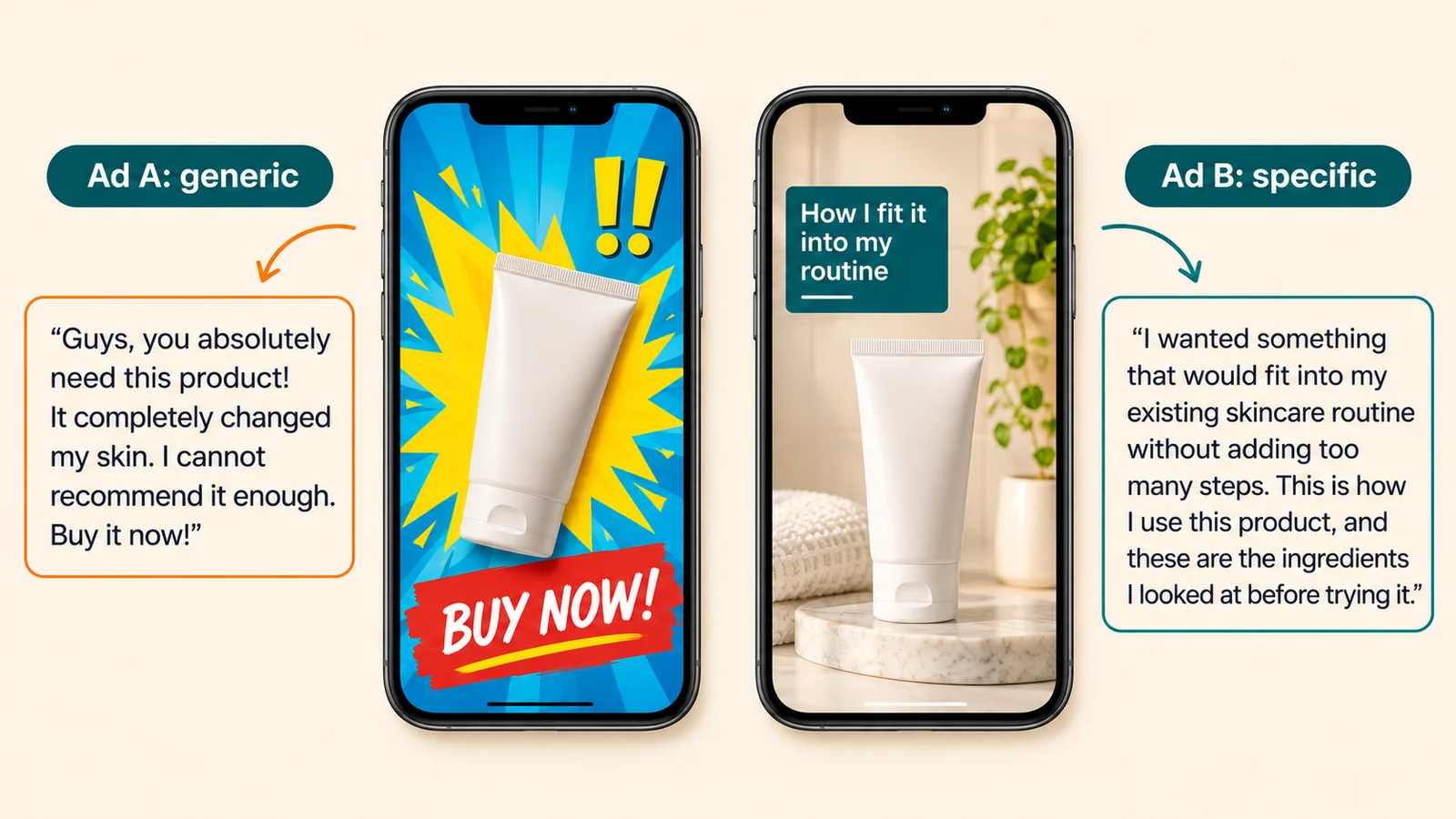
Neither example guarantees better performance. But the second gives the audience context and a consideration that might matter to someone evaluating the product.
When does a UGC ad stop feeling authentic?
1. Every creator uses the same script. When multiple videos open with identical phrases, follow the same sequence and end with the same promotional line, the content feels manufactured.
2. It makes broad claims without demonstrating anything. “The best product ever” and “you need this in your life” are not informative without a reason to believe them.
3. It sells before explaining. A strong call to action has a place in advertising, but viewers first need to understand what is offered and what problem it addresses.
The solution is not to remove all structure from UGC ads. It is to give creators enough direction to communicate the right message while letting them deliver it naturally.
4. Creative Direction vs Over-Scripting
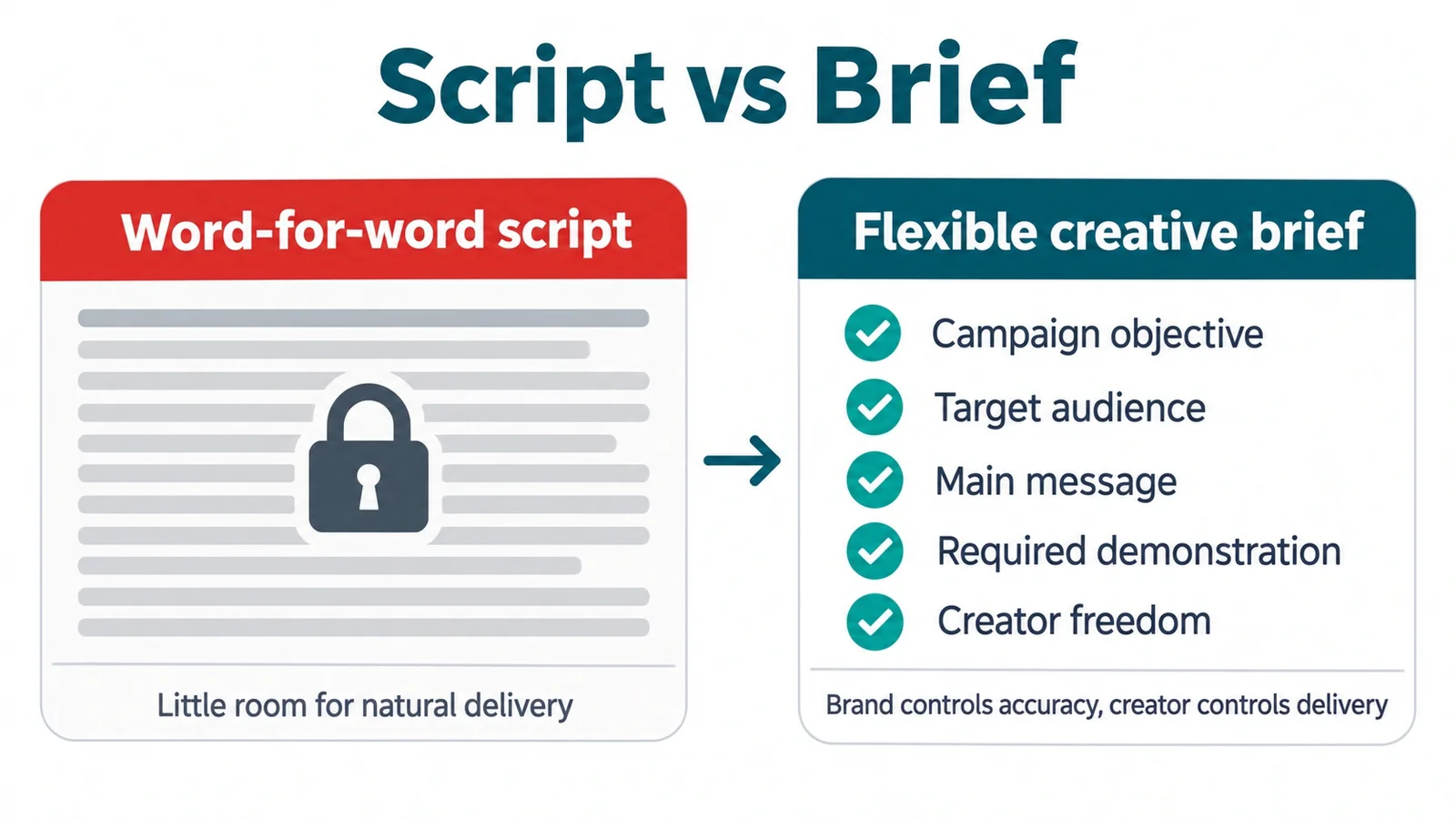
One of the biggest mistakes brands make is confusing a detailed creative brief with a word-for-word script. Creators need to understand the objective, audience, product features, required information and any claims to avoid. But controlling every sentence and reaction makes the final video sound unnatural.
Example: how to improve a creator brief
Imagine a brand advertising a project management application.
A restrictive brief might say:
“Start the video by saying, ‘I have finally found the perfect project management tool.’ Then show the dashboard, point to the task manager and say that it saves hours every week. End by saying, ‘Sign up today.'”
This leaves the creator little room to communicate naturally, and it encourages a broad claim that may not reflect their actual experience.
A more useful brief looks like this:
Campaign objective: Introduce the application to people who struggle to organise multiple projects.
Target audience: Freelancers, small teams and independent professionals.
Main message: Show how the application helps organise tasks and track project progress.
Suggested opening angle: Talk about a common difficulty when managing several projects at once.
Required demonstration: Show how to create a task, assign a deadline or organise work using the actual application.
Important points: Mention only features that have been verified. Avoid unsupported claims about productivity or time savings.
Creator freedom: Use your own words and explain the feature in a way that reflects your actual experience.
Call to action: Encourage viewers to explore the application or visit the website.
The brand controls the message and factual accuracy, while the creator keeps freedom over the delivery.
5. Finding UGC Ad Ideas From Actual Customer Feedback
A common mistake is starting with viral ads and trying to reproduce them. A better starting point is what customers already ask, discuss and struggle with.
Start with customer reviews
Read both positive and negative reviews. Positive reviews show which benefits customers value. Negative reviews reveal concerns a new ad may need to address. If customers repeatedly say a product is hard to assemble, the ad could walk through assembly from start to finish instead of just saying it’s easy to use.
Look at frequently asked questions
Support conversations, website FAQs, social comments and sales enquiries reveal recurring questions. For a software company, these might be: Is it suitable for beginners? Can multiple team members use it? Does it work with existing tools? How long does setup take? Each question is a potential content angle.
Turn objections into demonstrations
If customers are unsure whether a product suits a small space, don’t say “perfect for every home.” Show it being used in a compact room.
A practical customer-insight worksheet
| Customer insight | What the ad should communicate | Possible creative |
|---|---|---|
| Customers find setup confusing | Show the setup process clearly | Step-by-step tutorial |
| Buyers are unsure about product size | Help them understand dimensions | Product shown in a real setting |
| Users value a particular feature | Demonstrate how the feature works | Feature walkthrough |
| Customers compare alternatives | Explain relevant differences accurately | Comparison video |
| Beginners worry about complexity | Show the first steps | Beginner-focused demonstration |
The goal is to connect every creative idea to an actual customer question or need.
6. What Makes a UGC Ad Feel Authentic?
Authenticity is not a particular visual style or camera angle. It comes from the relationship between the message, the product and the experience being communicated.
- Specific experiences instead of generic praise. “This is an amazing product” says little. “I use this feature to organise my weekly tasks, so I can see what needs attention first” gives the viewer something concrete.
- Demonstration instead of description. If a product has a useful feature, show it. If it requires setup, show the steps.
- The right creator for the product. Relevance isn’t determined by follower count alone. Consider whether their audience needs the product, whether they can explain it accurately, whether their style suits the campaign, and whether they have real experience with it when the ad implies personal use.
- Honest claims. Don’t ask creators to claim results they haven’t experienced. Avoid invented testimonials, misleading before-and-after comparisons and unsupported performance claims. If content is sponsored, disclose the commercial relationship appropriately.
- Usefulness before the call to action. A viewer should learn something from the ad, whether that’s how a feature works, what problem it addresses or what to consider before buying.
Disclosure rules vary by country and platform. As one example, the US Federal Trade Commission publishes Disclosures 101 for Social Media Influencers, a plain-language guide to disclosing sponsored content. It is US guidance, not a universal requirement, so check the rules that apply in your market and on each platform.
7. How to Create UGC Ads: A Step-by-Step Process
Treat UGC ad creation as an advertising process, not just a video-production task.
Step 1: Choose one audience problem
Don’t start with a vague goal like “make a video that promotes our product.” Pick one problem, question or buying consideration. For example: a project management tool wants to reach freelancers who struggle to keep track of multiple deadlines.
Step 2: Decide what the viewer should understand
Choose one primary message, such as “See your tasks and deadlines in one organised workspace.” Don’t try to communicate every feature in one short video.
Step 3: Choose the right creative format
| Campaign objective | Suitable UGC-style format |
|---|---|
| Explain how a product works | Product demonstration |
| Address a common concern | Question-and-answer video |
| Introduce a product | Unboxing or first-look video |
| Explain a process | Step-by-step tutorial |
| Show a real customer experience | Customer testimonial, with permission |
| Compare product options | Feature comparison |
UGC-style creative can run across several ad formats and placements. This overview of the types of Meta ads is a useful reference when deciding where each format fits.
Step 4: Prepare a creative brief
Give the creator the campaign objective, intended audience, main product benefit, required product information, suggested creative angle, restrictions on claims, deliverable specifications, usage rights and disclosure requirements (see Section 4 for an example).
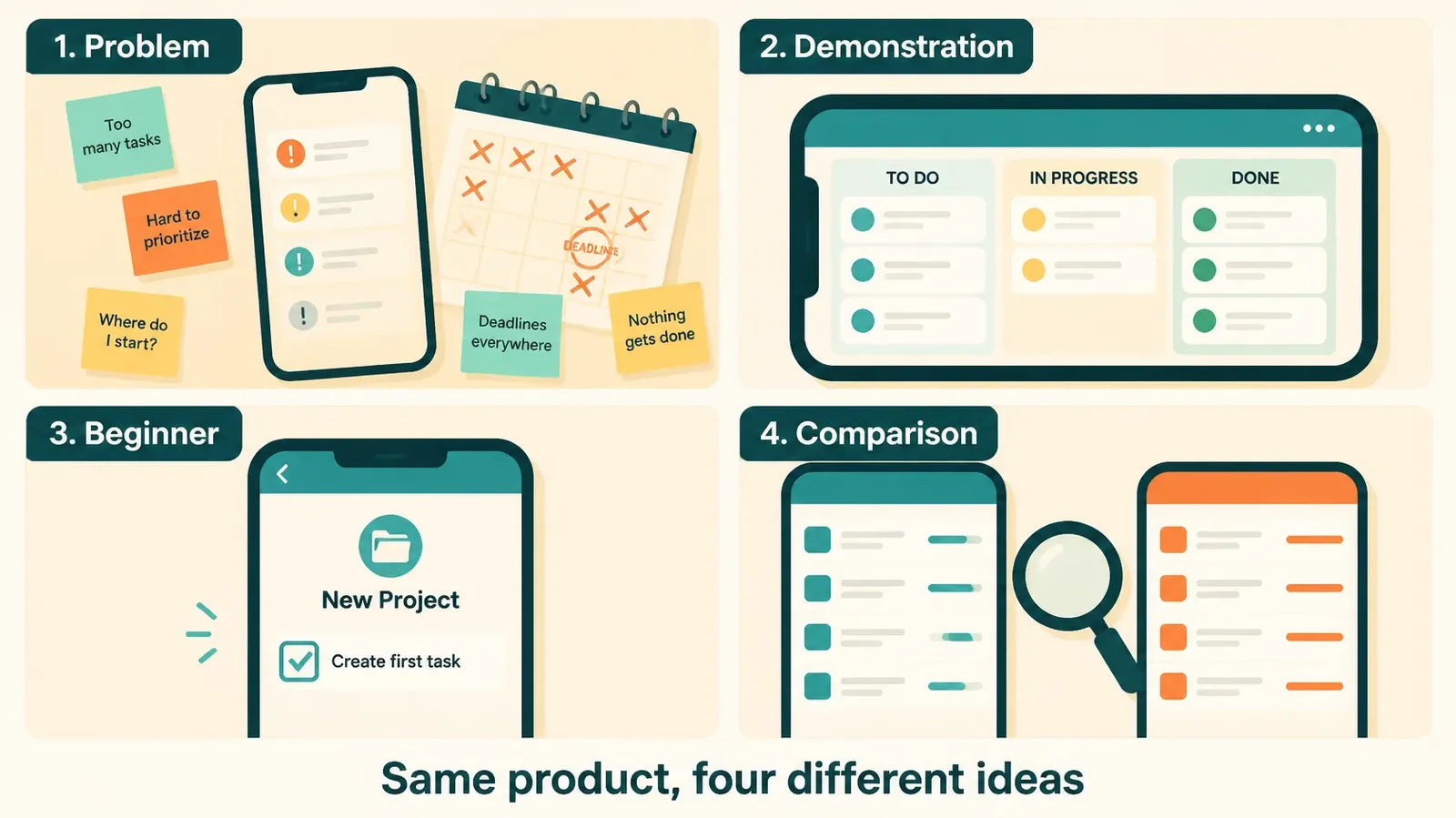
Step 5: Produce variations with genuinely different ideas
Producing more videos is not the same as testing more ideas. If five videos open with a similar hook, list the same three benefits and end with the same call to action, the brand has one ad made five times. Instead, explore different customer motivations. For the project management app:
- The problem angle: Struggling to remember multiple deadlines?
- The demonstration angle: See how to organise tasks in one workspace.
- The beginner angle: How to get started with a simple project.
- The comparison angle: What to consider when choosing a project management tool.
These are meaningfully different concepts, not minor tweaks to the same ad.
Step 6: Review before launch
Check that the product is represented accurately, the main message is easy to understand, the demonstration matches the claims, the creator’s statements are truthful, required disclosures are present, audio and video are clear, and the call to action leads to the correct destination.
Step 7: Launch, measure and learn
Evaluate performance against the campaign objective, not views alone. A video meant to generate leads should be judged on lead-related results. Let the data inform the next creative.
8. How to Measure UGC Ad Performance
A UGC ad can attract attention without generating business results, so measurement should start with the campaign objective. An awareness campaign and a lead-generation campaign shouldn’t be judged the same way.
Metrics to consider
| Metric | What it helps you understand |
|---|---|
| Impressions | How many times the ad was displayed |
| Reach | How many people saw the ad |
| Video views and watch time | How people consumed the video |
| Engagement | Whether people interacted with the content |
| Link clicks | Whether viewers showed interest in visiting the destination |
| CTR | The proportion of impressions that generated clicks |
| CPC | The average cost per click |
| Leads or purchases | Whether the campaign generated the intended action |
| Cost per result | How much the campaign spent to generate the selected result |
| ROAS | Revenue generated relative to advertising spend, where applicable |
Interpret these together. A video may get strong engagement but few website visits, while another gets fewer interactions but attracts more qualified visitors.
CTR vs conversion rate: These two are often confused. CTR (click-through rate) is clicks divided by impressions, so it shows how many people who saw the ad clicked it. Conversion rate is conversions divided by clicks, so it shows how many of those visitors then completed the intended action, such as a purchase or a lead form. A high CTR with a low conversion rate may indicate a mismatch between the ad and the landing page, an unclear offer, audience targeting issues or problems with the conversion process. Review the entire journey before deciding where the problem lies. For definitions of other metrics, see this Meta Ads metrics list.
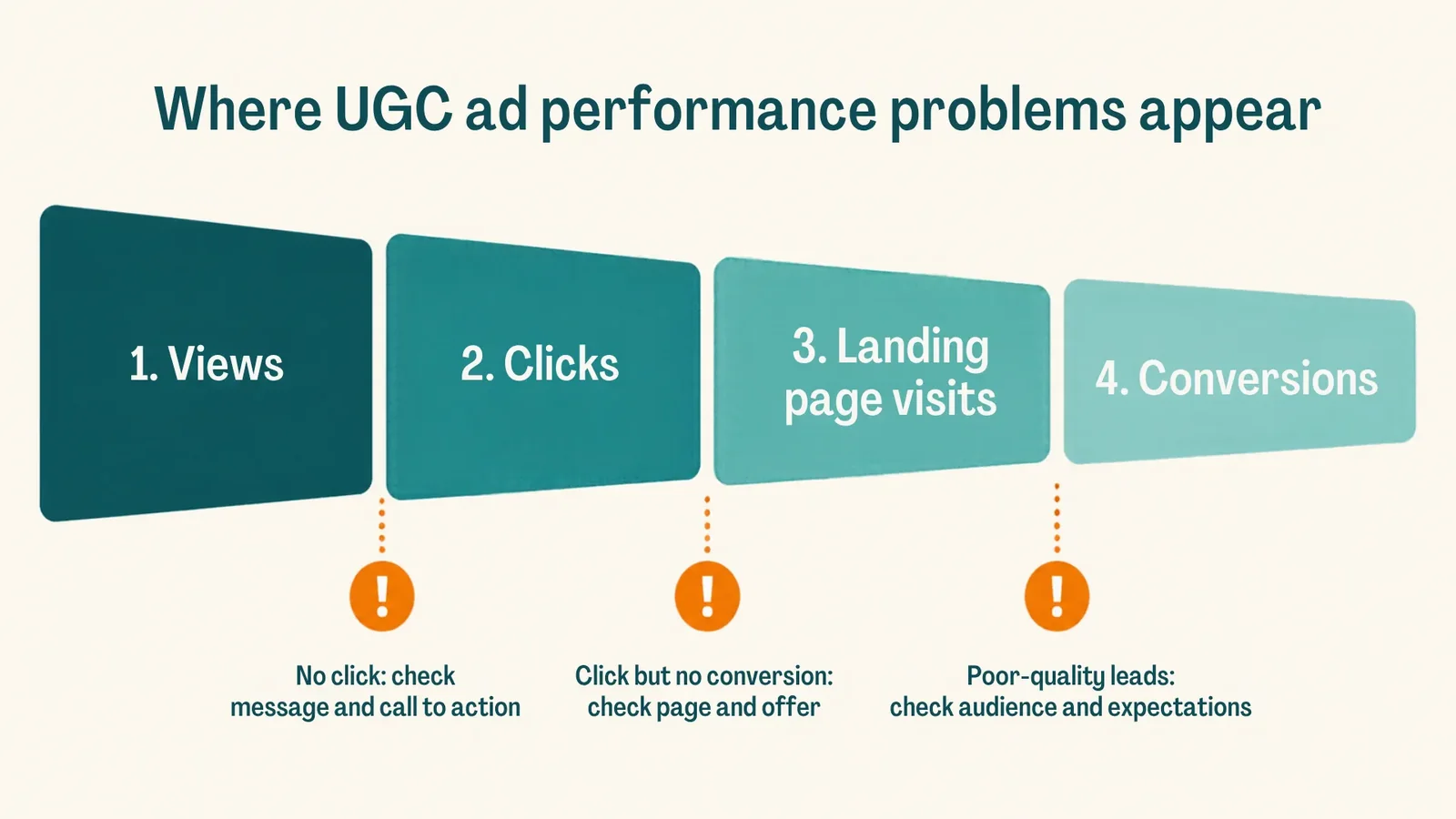
What if your UGC ad gets views but no conversions?
Don’t immediately assume the creative is the problem. Investigate the full journey.
Situation 1: People watch but don’t click. Is the product benefit clear? Does the ad address a relevant need? Is the call to action clear? Does the offer give viewers a reason to take the next step?
Situation 2: People click but don’t submit a form or purchase. Look beyond the ad. Does the landing page match the promise made in the video? Is pricing or the offer clearly explained? Is the page easy to use on mobile? Does the form ask for unnecessary information? Are there trust concerns or missing product details?
Situation 3: People engage, but leads are poor quality. Is the ad attracting the right audience? Does the messaging create unrealistic expectations? Is the offer relevant? Does the landing page make clear who the product or service is for?
Advertising performance depends on more than creative. Audience selection, campaign setup, the offer and the landing page all influence the result.
A simple creative testing log
| Creative | Main angle | Hook | Result to monitor | Learning |
|---|---|---|---|---|
| Ad A | Problem-focused | Common customer frustration | CTR and conversions | Did the problem resonate? |
| Ad B | Product demonstration | Show the feature immediately | Watch time and clicks | Did the demonstration create interest? |
| Ad C | Objection-focused | Address a common concern | Leads or purchases | Did answering the concern improve action? |
Record the audience, budget, objective and testing period alongside results so comparisons are meaningful. Don’t declare a winner from a very small or unequal sample. Give each test enough time and delivery to produce useful evidence.
9. Human-Created UGC vs AI-Generated UGC-Style Ads
AI tools can assist with scripting, editing, subtitles, concept development, voice generation and synthetic video. Used openly and accurately, they can be a practical part of a creative workflow. The question to ask is not whether content is AI-assisted, but whether it represents the product and the experience honestly.
| Consideration | Human-created UGC | AI-generated UGC-style content |
|---|---|---|
| Personal experience | Can communicate an actual experience | Cannot independently have personal product experience |
| Production | Requires a creator or customer | Can reduce some production requirements |
| Creative control | Depends on the creator and brief | Often allows greater control over generated elements |
| Product demonstrations | Can show actual use | Can illustrate features, but accuracy needs checking |
| Trust considerations | Depends on honesty and disclosure | Requires care to avoid presenting synthetic experiences as real |
AI is useful for early concepts, storyboards, exploring hooks, editing and adapting existing content, subtitles and translations, and explanatory visuals such as product walkthroughs. The line to hold is honesty: don’t present a synthetic character as a real customer, or invent testimonials and experiences that never happened.
Frequently Asked Questions About UGC Ads
What does UGC stand for in advertising?
User-generated content. In advertising it covers content created by customers, paid creator content, and ads designed in a similar style. These are not the same type of experience, so it helps to distinguish them.
Are UGC ads better than traditional ads?
Not in every situation. UGC-style ads suit demonstrations, customer experiences and conversational messaging. Traditional ads may suit other objectives. The right choice depends on the audience, product and campaign goal.
Do UGC ads need to look unprofessional?
No. Authenticity doesn’t mean poor lighting or unclear audio. A UGC ad can be professionally produced and still feel natural and believable.
Can brands use paid creators for UGC ads?
Yes, as long as the product is represented honestly, the commercial relationship is disclosed and usage permissions are clear.
Can AI create UGC ads?
AI can generate UGC-style videos, visuals and scripts, but synthetic content should not be presented as a genuine customer’s experience when no such experience exists.
How many UGC ads should a brand create?
There is no universal number. Start with a few meaningfully different concepts based on customer problems, benefits and objections, then use results to decide what to test further.
What should brands measure in UGC ad campaigns?
It depends on the objective. Relevant metrics include watch time, engagement, CTR, CPC, leads, purchases, cost per result and ROAS. The key question is whether the campaign is achieving the outcome it was designed for.
Conclusion
UGC ads aren’t effective simply because they look like ordinary social media content. Their value comes from how clearly they communicate a product, demonstrate its usefulness and address the questions people have before making a decision.
Start with customer feedback. Identify a real problem or buying consideration. Give creators a clear brief without controlling every word. Demonstrate the product honestly, test genuinely different angles and evaluate what happens after someone sees the ad.
Authenticity isn’t something a brand can create by adding casual language or making a video look less polished. It comes from having something relevant and believable to communicate.
For more practical insights on digital advertising, explore the resources from Harmukh Technologies, covering paid advertising, marketing strategies and digital growth.